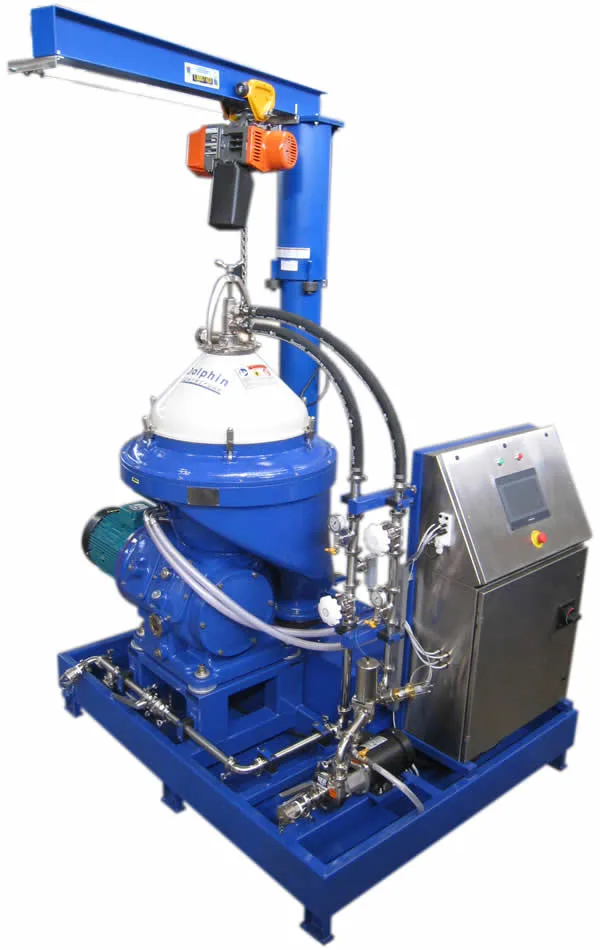
Summary: A semiconductor facility generating 50,000+ gallons of silica-contaminated wastewater daily replaced its ultra-filtration membrane system with a self-cleaning disc stack centrifuge: a Dolphin DMPX-070 module built on a remanufactured Alfa Laval WHPX 513. The result: annual savings of $1,279,000, near-zero consumable costs, and water clean enough to recycle back into the grinding process.
The Challenge
In semiconductor manufacturing, cutting and grinding silicon wafers with diamond blades generates large volumes of contaminated water containing fine silica and diamond particles. These particles are extremely small, often sub-micron in size, making them difficult to remove with conventional methods.
This facility was processing over 50,000 gallons of grinding wastewater every day. Their existing ultra-filtration system used membrane cartridges that cost $350 each and required replacement every 3 to 6 hours due to rapid clogging from the fine abrasive particles. With four membranes per cycle, the annual membrane cost alone reached approximately $1,400,000. Additional labor costs of $33,000 per year were incurred from the constant membrane swaps, and the frequent downtime disrupted production schedules.
The Centrifuge Solution
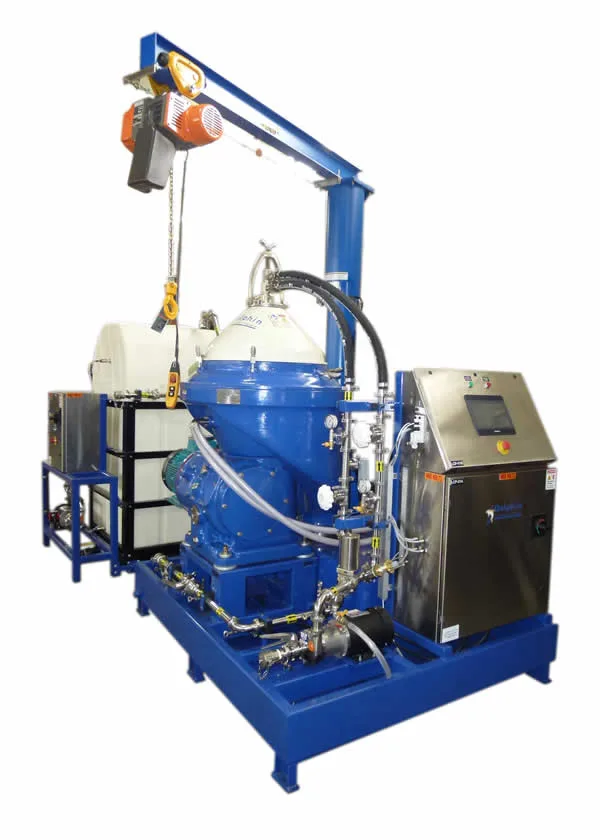
Dolphin Centrifuge recommended a DMPX-070 (Alfa Laval WHPX 513) self-cleaning disc stack centrifuge rated at 50 gallons per minute for this application. Unlike membrane filters that physically trap particles and clog, the centrifuge uses centrifugal force exceeding 8,000 Gs to drive fine silica and diamond particles to the bowl wall, where they accumulate and are automatically ejected during periodic self-cleaning discharges.
DMPX-070 is Dolphin's module code. The skid, controls, pumps, and piping are Dolphin engineering; the centrifuge inside is a remanufactured Alfa Laval WHPX 513, stripped, rebuilt, balanced, and test-run in Warren, Michigan. Dolphin Centrifuge is the independent specialist in Alfa Laval centrifuges, with remanufactured machines, turnkey systems, parts, and service built on 40+ years of Alfa Laval experience and led by Sanjay Prabhu, M.S.M.E. Dolphin is an independent remanufacturer and is not affiliated with Alfa Laval.
Pilot Scale Testing
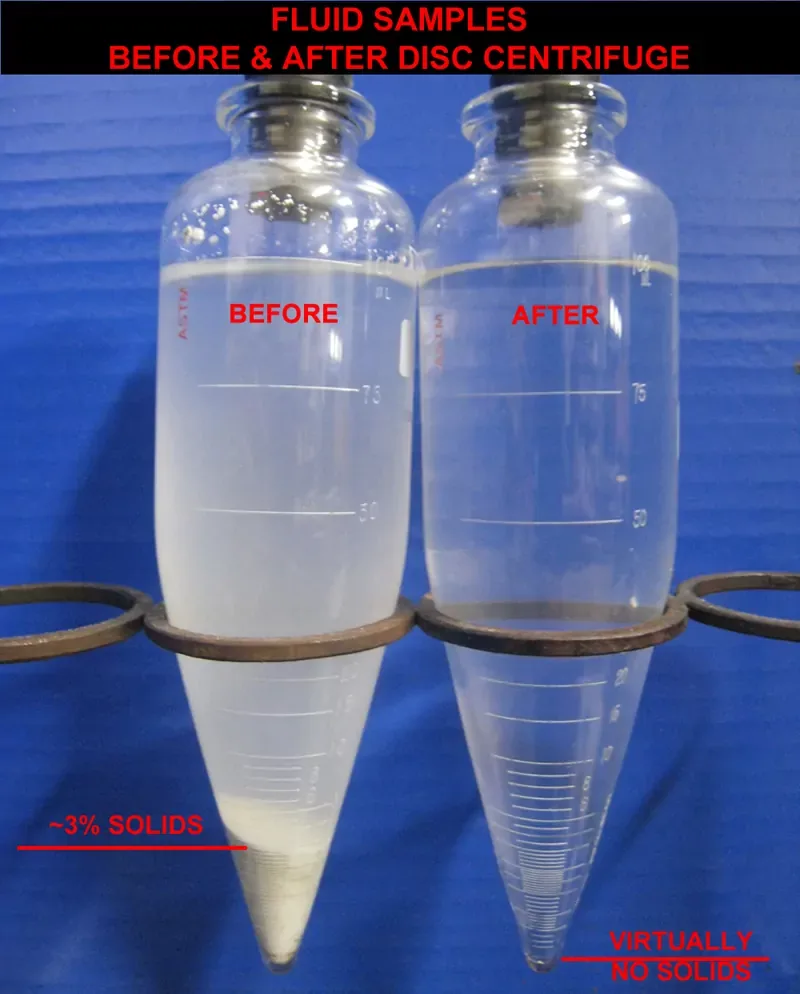
Before committing to a full-scale installation, Dolphin Centrifuge conducted pilot-scale testing using a 1-gallon sample of the facility's grinding wastewater. The test demonstrated complete removal of particle contamination, producing clear, reusable water suitable for recycling back into the grinding operation. Learn more about our industrial centrifuge sample testing process.
How the Disc Stack Centrifuge Works
The wastewater centrifuge operates continuously using the following separation principle:
- Feed inlet: Contaminated wastewater enters through a central feed tube into the spinning bowl
- Centrifugal separation: The bowl spins at high speed generating forces up to 10,000 Gs, driving dense silica and diamond particles outward to the bowl wall
- Disc stack: Conical discs stacked inside the bowl increase the effective settling area, enabling separation of particles down to a fraction of a micron
- Clean water discharge: Clarified water flows toward the center of the bowl and exits through an outlet, ready for reuse
- Automatic sludge ejection: Accumulated particles are periodically discharged from the bowl automatically, with no manual intervention required
Cost Comparison
| Cost Category | Ultra-Filtration | Centrifuge System |
|---|---|---|
| Consumables / Electricity | $1,400,000 | $125,000 |
| Labor / Maintenance | $33,000 | $4,000 |
| Depreciation | n/a | $25,000 |
| Total Annual Cost | $1,433,000 | $154,000 |
The centrifuge system delivered annual savings of approximately $1,279,000 compared to the ultra-filtration approach, an 89% reduction in operating cost.
Advantages Over Ultra-Filtration
- No consumable media: The centrifuge has no membranes or filter cartridges to replace, eliminating the $1.4M annual consumable cost
- Continuous operation: The self-cleaning mechanism runs without interruption, unlike membranes that require constant swaps every few hours
- Sub-micron separation: Disc stack centrifuges separate particles down to a fraction of a micron, matching or exceeding membrane performance
- Minimal labor: Automated sludge discharge reduces operator intervention to routine monitoring
- Water recycling: The clean centrate is suitable for reuse in the grinding process, reducing fresh water consumption
Environmental Benefits
By enabling on-site water recycling, the centrifuge system significantly reduced the facility's fresh water demand and the volume of contaminated wastewater requiring external disposal. The elimination of disposable membrane cartridges also removed a substantial solid waste stream. Lower overall energy consumption compared to continuous membrane pumping further reduced the facility's environmental footprint.
For semiconductor, glass, and other precision-grinding operations facing similar wastewater challenges, a disc stack centrifuge offers a proven, cost-effective alternative to membrane filtration. Contact Dolphin Centrifuge for sample testing with your grinding wastewater.
Conclusion
Switching to a disc stack centrifuge for wastewater offers an effective solution for the silicon wafer facility's wastewater management challenges. The industrial wastewater centrifuge in this case study, a Dolphin DMPX-070 module built on a remanufactured Alfa Laval WHPX 513, efficiently handles fine particle contamination, provides significant cost and labor savings, and promotes sustainable operations. With continuous operation, minimal maintenance, and environmental benefits, the centrifuge system is a valuable investment for high-volume wastewater treatment in the semiconductor manufacturing industry.
Send Us Your Grinding Wastewater Sample
Our engineers will test your actual wastewater and provide a separation report. Confirm centrifuge performance before any commitment. Sample testing is a chargeable service.