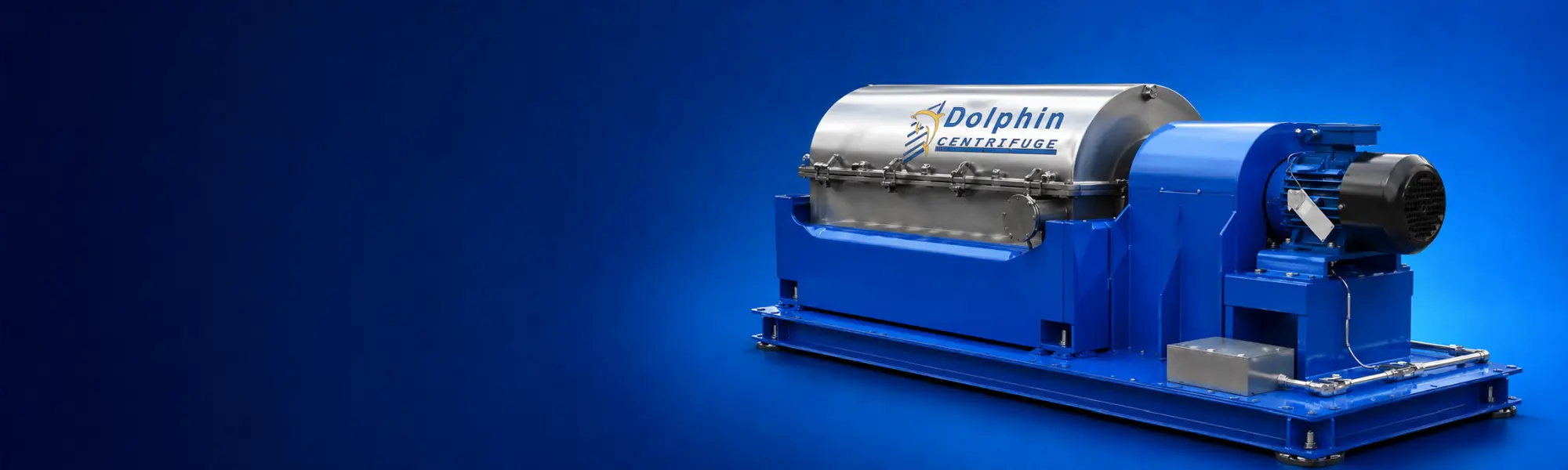
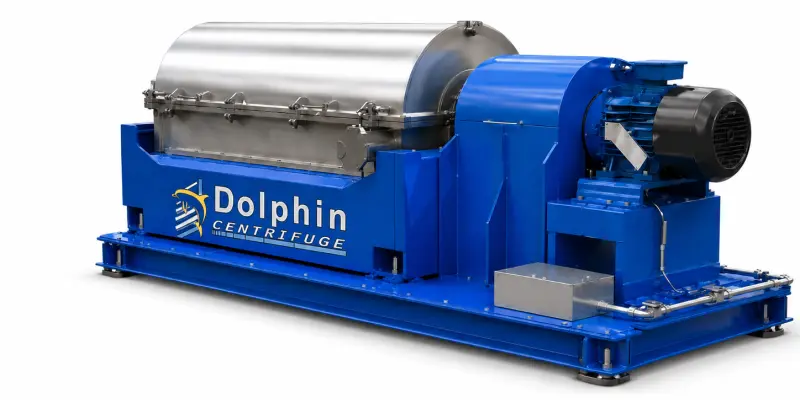
The Sharples P-3400 Decanter Centrifuge is a horizontal de-sludging centrifuge built for the two-phase separation of crude oil tank bottoms, refinery slop sludge, industrial sludge-thickening, municipal sludge dewatering, paint sludge handling, etc.
With a 25 HP Motor, the P 3400 decanter has a bowl RPM of 4,000 and can process 50 GPM on ethanol hemp biomass separation.
The Sharples and Pennwalt Super-D-Canter decanter line is now part of Alfa Laval, so a P-3400 is an Alfa Laval platform machine today. Dolphin Centrifuge is the independent specialist in Alfa Laval centrifuges: we buy, remanufacture, stock, and support used Sharples P-3400 decanters alongside Alfa Laval NX, G2, and ALDEC machines, rebuilt and test-run at our Warren, Michigan shop and shipped with a warranty and free ongoing technical support. Every system is engineered by Sanjay Prabhu, M.S.M.E. Dolphin is an independent remanufacturer and is not affiliated with Alfa Laval.
Applications
| Hemp Solvent Extraction | Hemp biomass & ethanol separation (Explosion Proof) |
| Ethanol Extraction | Ethanol extraction of THC or CBD Oil |
| Crude Oil Tank Bottom Sludge | Tank bottom BS&W separation |
| Municipal Wastewater | Sludge thickening |
| Liquid Humus Fertilizer | Humus biomass separation |
| Fish Meal Separation | Fish oil & fish meal separation from stickwater |
| Pyrolysis Sludge Separation | Bio-oil separation from bio-char sludge |
| Waste Oil De-sludging | Industrial waste oil de-sludging |
Specifications
| Model Type | Sharples P-3400 |
| Manufacturer | Sharples / Pennwalt (Alfa Laval) |
| Rated Capacity | 50 GPM on Ethanol Biomass Separation |
| Auger Differential Speed | 1 ~ 42 RPM |
| Drive Motor Power | 25 HP |
| Gearbox Ratio | 1: 95 |
| AE (Area Equivalent) | 1,500 |
| Bowl Speed | 4000 RPM (3,150 Gs RCF) |
| Conveyor Protection | Carbide Tile or Tungsten Carbide Hard-Surfacing |
Super-D-Canter Overview
The Pennwalt Super-D-Canter is a specially developed solid-bowl centrifuge for effective separation of slurries into liquid and solid phases.
The Pennwalt and Sharples Super-D-Canter decanter line passed to Alfa Laval, which carries the platform forward today. Dolphin Centrifuge remanufactures and supports these machines independently, the same way we do the Alfa Laval NX 418 and G2-40 decanters.
The Super-D-Canter operates on the centrifugal sedimentation process.
The Pennwalt Super-D-Canter becomes an extremely flexible separation tool with application areas involving clarification of liquids, classification of solids, concentration of solids, and dewatering of solids.
The Super-D-Canter can handle a wide range of solid particles from 6 mm dia. to a few microns and a slurry concentration varying from 0.5% to over 65% w/w.
P-3400 / PM 30000 Specifications
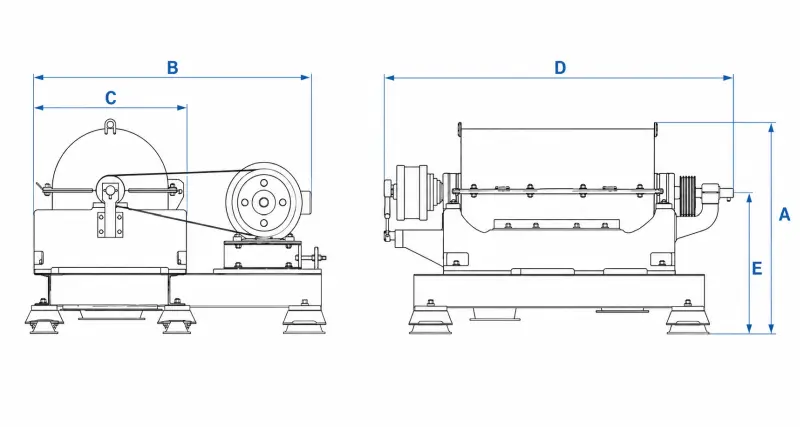
| Specification | P-3400 / PM 30000 |
|---|---|
| Max gravity | 3180 G / 2100 G |
| RPM | 4000 / 3150 |
| Max power | 40 HP |
| Dimension A | 672 mm |
| Dimension B | 1619 mm |
| Dimension C | 813 mm |
| Dimension D | 2294 mm |
| Dimension E | 294 mm |
| Net weight | 1400 kg |
The dimensions given above are approximate. Specifications are subject to change without prior notice as part of continuous technology updates.
Continuous Operation
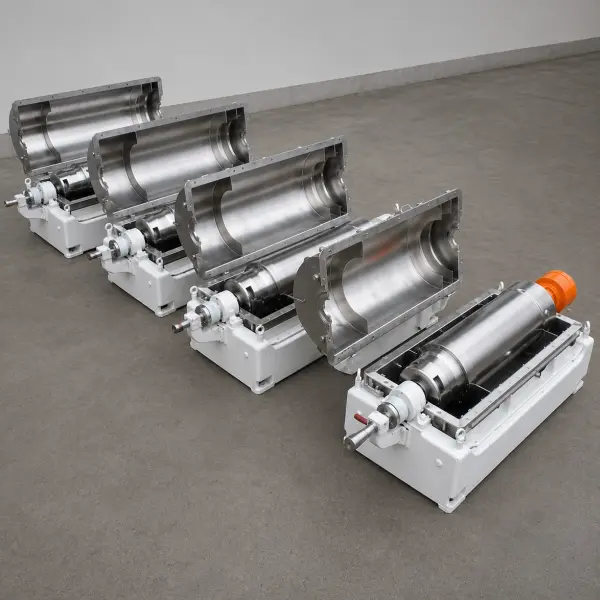
Solids are continuously separated from the liquid phase by the application of centrifugal force ranging to well beyond 3000 times the force of gravity.
The denser solid particles are sedimented against the rotating bowl wall. The less dense liquid phase forms a concentric inner layer.
Adjustable dam plates enable the depth of liquid or pond to be varied.
The sedimented solid particles are continuously removed from the bowl by the action of the helical screw conveyor or scroll. Clarified liquid overflows the dam plates situated at the opposite end of the bowl.
Construction & Wear Protection
Stainless steel process contact parts are preferred because carbon steel corrodes. Corrosion leads to product contamination, unbalance, high maintenance and long downtime.
The stressed rotating assemblies and principal elements of the Super-D-Canter centrifuge are machined from centrifugally cast stainless steel.
All wear-prone areas of the centrifuge, feed zone, solids discharge, bowl and scroll are protected by hard surfacing.
The Pennwalt tungsten carbide tiling system has enabled Super-D-Canter centrifuges to operate trouble-free on abrasive duties which had not previously been possible.
Sintered tungsten carbide is upto 50 times more resistant to wear than flame applied hard facing material.
Performance Factors
Four crucial factors govern the performance of decanter centrifuges: centrifugal force required to sediment the solids, clarification necessary to capture the solids, differential speed required between the bowl and scroll to convey the solids, and hydrodynamic design to minimise turbulence.
The correct combination of such features ensures the desired performance at minimum cost.
Selected Applications
Animal Blood, Antibiotics, Brewers Grains, Calcium Carbonate, Calcium Sulphate, Cannery Effluent, Chemical Intermediates, Coal Tailing, Cutting Oils, Distillery Stillage, DMT, Drilling Mud, Dyestuffs, Electroplating Solutions, Enzymes Harvesting, Ethanol Stillage Dewatering, Fine Chemicals, Fish Liquors, Food Processing Effluents, Fruit Juices and Pulp, Industrial Effluents, Inedible Tallow, Instant Tea, Insulin Tissue Separation, Lactose, Municipal Sewage, Nuclear Effluents, Petrochemicals, Pharmaceuticals, Pigments, Polymers, Polystyrene, PTA, PVC Dewatering, Refinery Effluent, Slop Oil Pretreatment, Sodium Sulphate, Synthetic Fibres, Titanium Dioxide, Vegetable Oils.
Used and Remanufactured Sharples P-3400 Decanters
Apart from Alfa Laval itself, Dolphin is the reliable source in the United States for quality used and remanufactured Sharples, Pennwalt, and Alfa Laval decanter centrifuges. We buy used P-3400 machines, strip and inspect them, replace bearings and seals, rebuild or hard-surface the conveyor with tungsten carbide, balance the rotating assembly, and test-run the unit before shipment. A remanufactured P-3400 typically costs 40% to 60% of a comparable new decanter.
Units can be supplied bare-shaft or as a complete module with base frame, feed pump, VFD drives, and a PLC control panel, including explosion-proof builds for hemp and ethanol extraction. Every machine ships with a warranty, on-site startup and training, and free ongoing technical support from an engineer-led team headed by Sanjay Prabhu, M.S.M.E. Call (248) 522-2573 or email sales@dolphincentrifuge.com to check current P-3400 availability, or see our full decanter centrifuge line and rental fleet.
Frequently Asked Questions
Who makes the Sharples P-3400 decanter centrifuge today? ▼
The Sharples and Pennwalt Super-D-Canter decanter line is now part of Alfa Laval, so a P-3400 is an Alfa Laval platform machine. Dolphin Centrifuge is the independent specialist in Alfa Laval centrifuges and buys, remanufactures, stocks, and supports used P-3400 decanters. Dolphin is an independent remanufacturer and is not affiliated with Alfa Laval.
Can I buy a used or remanufactured Sharples P-3400 decanter? ▼
Yes. Dolphin Centrifuge keeps used Sharples P-3400 decanters in stock and remanufactures them at its Warren, Michigan shop. Each machine is stripped and inspected, bearings and seals replaced, the conveyor rebuilt or hard-surfaced with tungsten carbide, the rotating assembly balanced, and the unit test-run before shipment. A remanufactured P-3400 typically costs 40% to 60% of a comparable new decanter.
What are the Sharples P-3400 specifications? ▼
The P-3400 runs a bowl speed of 4,000 RPM for about 3,150 G, uses a 1:95 gearbox with an auger differential of 1 to 42 RPM, and is driven by a 25 HP motor. Rated capacity is 50 GPM on ethanol biomass separation. Wear surfaces are protected with carbide tile or tungsten carbide hard-surfacing.
How does the P-3400 compare with the Sharples P-3000 and the Alfa Laval NX decanters? ▼
The P-3400 is the large-capacity machine in the Sharples line, above the smaller P-3000. Dolphin also remanufactures the Alfa Laval NX 314, NX 418, CHNX 418, and G2-40 decanters, so the selection comes down to flow rate, solids loading, and area classification rather than availability. Sanjay Prabhu, M.S.M.E., sizes the machine to the actual process data.